As an unapologetic lover of ‘tales as old as time’ for eras before my fantasy novel Hydranos came to be, I can’t help but stop in my tracks whenever I come across a unique story from another corner of the world. The wisdom masterfully condensed within the few lines of a folk tale is sometimes found nowhere else. Like mirrors and treasure chests of other eras and customs, the tales come from the depths of the ages to often take us on a journey to the most forgotten corners of our very souls.
From this inexhaustible fountainhead of Korean folk myths and legends flows the story of the Snail Bride.

According to the myth of ‘Ureong Gaksi’ (우렁각시), once upon a time, there lived a very poor farmer who worked in the fields all day yet barely made a living and supported his elderly mother. Due to his poverty, he also struggled to find a wife. So, one exhausting day working in the rice paddy, he asked aloud in despair: “But who will I share all this rice with?” And there, out of nowhere, an ethereal voice responded: “Why, with me, of course!” The man was obviously startled; looking around frantically, there was no soul in sight other than himself. “But who will I share all this rice with?” he asked aloud again, only to get the exact same response. He looked around yet only rice stalks swayed in the wind. Until, when he looked down, his eyes fell upon a huge snail shell. He picked it up and took the shell home, keeping it safe inside a closet.
From that day on, whenever the farmer and his mother returned home from working in the rice paddy, a delicious meal with delicacies always awaited them on the table. As time passed and the mystery remained unsolved, one day the farmer pretended to leave for the field but instead stayed behind and secretly peeked into his house to see what was happening. To his utter surprise, he saw a beautiful girl slip out of the snail shell and prepare the delicious food. Overjoyed, the farmer then rushed into the house and at once asked the girl to marry him. However, she replied that she was punished by the heavens and that they had to wait three days (or, according to other versions of the myth, three months or three years), otherwise something terrible would happen to them. The farmer, though, was impatient and eventually convinced her to marry him that same day.
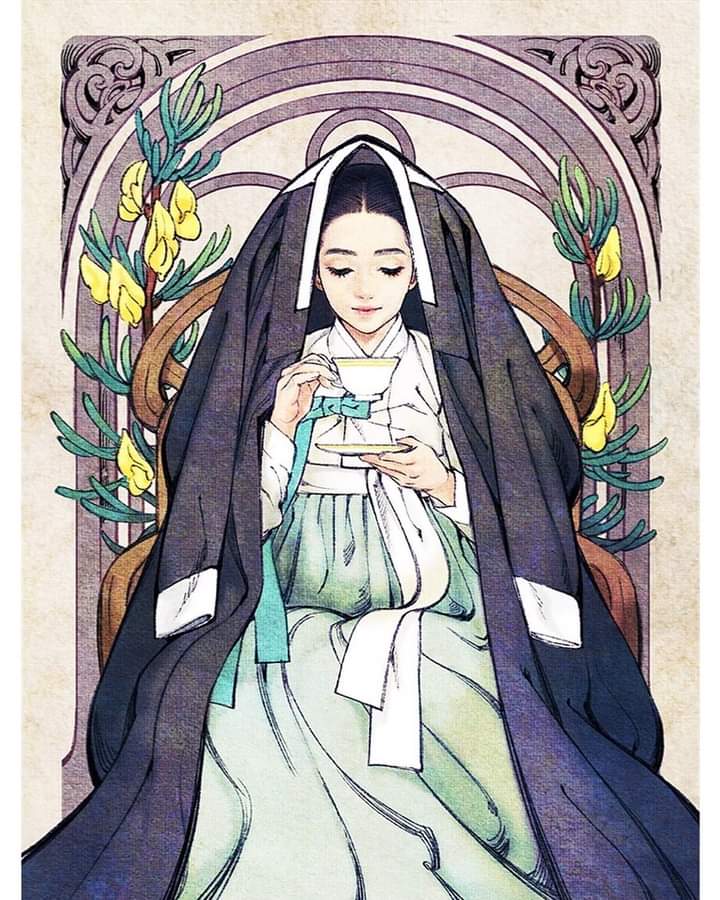
Because he feared that the girl might leave him to his loneliness and misery again, he never let her out of his sight and even forbade her from leaving the house. However, one day, the girl’s mother-in-law decided to stay home and eat there, so she sent her daughter-in-law to the rice paddy to take to her husband the meal she had, as always, prepared for him. On her way to the field, the girl encountered the procession of the local magistrate, and in her fright, she ran and hid in the forest. Nevertheless, the magistrate noticed a bright light among the foliage and instantly ordered one of his servants to go and investigate the source of the light and bring it to him, whether it was a flower or a person. The servant ventured among the trees until he found the Snail Bride trembling like a leaf with fear and with the lunch basket fallen at her feet. He dragged her out by the hand, while she extended her silver ring to him, pleading to be let go. In vain, though, as the magistrate eventually took her with him in his palanquin against her will.
When the farmer found out what had happened, he ran at once to the magistrate and begged him to release his wife. All his efforts, though, were in vain. Due to his unbearable sorrow, the man died and transformed into a bluebird. In turn, the Snail Bride refused to serve the magistrate and, as she would neither eat nor drink, she too died and transformed into a comb with elegant teeth.
Since ancient times, legends and myths about snails have been recorded in China, where they are considered good omens. One such story is titled “The Snail Bride” in the “Collection of Strange Stories” (Jiyiji) and also appears as an excerpt in the “Appendix to the Records of the Strange” (Shoushenhouji). According to the author and scholar Heinz Insu Fenkl, the above version of the tale dates back to 1912, during the Japanese occupation of Korea, which perhaps explains its particularly grim and tragic ending. Some other versions of the story have a happy ending, such as one by Heinz Insu Fenkl himself, based on material from the optimistic period of Korea’s economic boom in the 1980s. In another variation, once captured by the magistrate the bride refuses even to smile, so he decides to host a banquet in her honour. The girl’s husband appears at the celebration wearing a bird-feather costume and dances, making her smile. The magistrate then immediately asks the farmer to exchange costumes with him. When the farmer dons the magistrate’s dragon-embroidered attire, his wife encourages him to enter the magistrate’s office, leading to the latter’s expulsion. The farmer then takes the magistrate’s place as the local authority, and the story ends for the couple in a ‘happily ever after’.

Interpreting the moral lesson of this story, it is worth noting that it draws structural elements from initiation ceremonies and narrative endeavours that address the harsh sufferings of women. In the legend of the Snail Bride, the difference in the origin of each member of the couple is presented as an insurmountable obstacle, with the heroine being a fairy (seonnyeo – 선녀, “immortal woman”) who has found herself in the human world after being punished. The union of an immortal and a mortal violates the “divine law,” thus being condemned and ultimately destroyed by the forces of authority and resulting in tragedy. The Snail Bride herself does not have any actual agency but is treated as a “means” of intimidation or within the context of loss for the male characters in the tale. Emeritus Professor of English Literature Kim Seong-kon from Seoul National University identifies also a contrast in the gender roles of the time that gave birth to the variations of the story, as the multifaceted abilities, insight, and wisdom of the Snail Bride contrast with the impatience and sometimes inadequate skills of her husband.
The “Snail Bride” makes her ingenious appearance in our time and age, too—just look for her in the K-Drama world! There are several references to this tale in the episodes of “Fated to Love You,” where the character played by Jang Na-ra is even nicknamed “Snail.” Or, in the “Tale of the Nine-Tailed,” the “Snail Bride” runs her own, traditional restaurant named after her–the Insadong Hanok Teahouse of real-life Seoul)–which often becomes a place for meeting (or even for conflict) among the other mythical creatures in this fairy-tale series.
One thing is certain: Look twice the next time you come across a carefree snail!
Indicative bibliography:
The Snail-Shell Bride: bad things come to those who can’t wait
Korean men’s follies in folktales
More useful links:
Retelling of The Mud Snail Bride by Heinz Insu Fenkl
Cover art created on OpenArt.ai
Fairytales, myths and stories passed down from generation to generation can be a balm to the soul. Seek closely amidst the heartstrings of Hydranos and its epic fantasy tale, and who knows what magic it will unravel for you?
Next stop: Explore The Age of Stones universe or check out the free bookish downloads inspired by Hydranos!
 Constantina Maud
6 thoughts on “The Snail Bride | A Korean Fairy Tale”